
AI Ecosystems & Pilots
This page explains the delivery method used across all services: how AI models, agents, data, tools, human roles, governance controls, and operating rules are designed into scalable AI-enabled capability systems. An AI ecosystem is not a collection of isolated automations. It is the architecture that allows a new service, project model, participation process, knowledge function, or delivery system to operate reliably under real constraints.
In brief: An AI ecosystem is the governed operating environment where AI models, agents, data, tools, process logic, and accountable human roles are designed together to create or scale a specific organisational capability.
Section 1: AI Ecosystem process
What is an AI ecosystem?
An AI ecosystem is a governed capability system: technologies, data assets, operating rules, AI functions, and human responsibilities designed together to create, deliver, and improve a defined outcome over time. It connects intake (messages, documents, datasets), bounded AI capabilities (retrieval, drafting support, classification), process logic (routing, validation, iteration), systems of record, and oversight mechanisms (controls, logging, compliance checks).
Beyond improving existing routines, ecosystems enable new delivery capabilities—new service models, new coordination patterns, and new ways of running complex work under real constraints.
Core Components of an AI Ecosystem
1
AI Models & Capabilities
Large language models (LLMs), vision, classification, prediction and decision-support functions.
3
Orchestration and capability layer
The design and control layer that coordinates tools, agents, human roles, records, review points, exceptions, and escalation paths.
5
Tools & Integrations
Connected systems (CRM, documents, analytics, communications) via APIs or automation platforms.
7
Monitoring & Improvement
Logging, quality checks, and feedback loops to continuously improve performance and reduce risk.
2
Agents & Agentic Systems
Task-oriented agents with defined roles; multiple agents can collaborate under orchestration for multi-step work.
4
Data & Knowledge Layer
Databases, documents, APIs and retrieval mechanisms (including RAG) to ground outputs in reliable sources.
6
Human Roles & Governance
Humans set objectives, review sensitive outputs, handle exceptions, and remain accountable.
Why AI ecosystems matter
AI initiatives often stall at "tool level." A single assistant can draft text, but it cannot reliably run an operation end-to-end: it won't manage state, permissions, partner review cycles, exceptions, or audit trails. Ecosystems solve this by turning AI into governed capability infrastructure: a structured way to create new services, project systems, participation formats, knowledge processes, and accountable delivery models.
Reliability
Controlled steps and validation, not one-shot generation.
Traceability
Reconstructable inputs, transformations, and decisions.
Governance by Design
Oversight and risk controls are built in from the start.
Innovation
New ways of coordinating work across functions.
Repeatability
Consistent logic across teams and cases.
Scalability
Volume grows without proportional coordination overhead.
Quality & Consistency
Shared data, logic, and standards across operations.
Sustainability
Monitoring and continuous improvement loops.
Responsible AI Alignment
This approach supports widely used trust frameworks emphasising oversight, robustness, privacy/data governance, transparency, and accountability — including principles from the NIST AI Risk Management Framework and EU AI Act expectations.
Ecosystems Lifecycle
We use an iterative lifecycle informed by established risk-management practice, including the NIST AI RMF functions (Govern, Map, Measure, Manage) applied throughout design, deployment, and operation.
1 Discovery & Mapping
Objectives, constraints, stakeholders, systems, data flows
2 Ecosystem Design
Agent roles, workflow routes, governance controls, systems of record, metrics
3 Build & Integration
Orchestration logic + agents + data stores + interfaces
4 Quality & Safety Controls
Testing, review gates, exception handling, documentation
5 Pilot & Measurement
Live use, tuning, performance review, value confirmation
6 Scale & Operationalise
Expand scope, formalise runbooks, continuous improvement cycles
Method in Practice
We build AI-enabled systems that hold up in real operations: clear roles, explicit process rules, controlled data access, and measurable performance. We work end-to-end—from information flows and decision points to implementation details—so the system remains understandable and maintainable.
Working Principles
Apply AI only where the problem is clear and outcomes can be measured. Keep early versions small; expand scope only after pilot evidence. Require sign-off checkpoints for sensitive outputs and high-impact actions. Design for documentation, ownership, and long-term operation. Align with EU data protection and recognised responsible-AI expectations.
What Clients Receive
-
Ecosystem blueprint: components, integrations, records, and control points
-
Working pilot implementation: connected to agreed tools and data sources
-
Control design: responsibilities, sign-off routes, logging, escalation paths
-
Operating documentation: runbook, maintenance responsibilities, change process
-
Measurement plan: quality indicators, performance reporting, monitoring cadence
-
Scale plan: what expands next, prerequisites, and risk notes
Ecosystem Patterns Across Services
Proposal Delivery Ecosystem
An operating model that turns call documentation and consortium inputs into structured proposal assets with defined owners and review points.
Organisational Delivery Ecosystem
A system that standardises recurring operational work with shared records, quality checks, and accountable escalation.
Participation Delivery Ecosystem
A system that supports participant information, communications workflows, controlled synthesis support, and reporting—configured for legitimacy, transparency, and clear responsibility.
AI Ecosystem Graphic Presentation

Section 2 - AI Capability Pilots

Pilots are focused, real-world systems that deliver one proven result — built to scale.
AI Capability Pilots
Pilots validate whether a new AI-enabled capability is useful, governable, and worth scaling. Each pilot is a production-minded minimum system: a focused combination of AI functions, workflows, human roles, records, and review points designed to deliver one meaningful outcome.
How Pilots Are Implemented
-
Modular workflow orchestration: triggers/webhooks, step modules, branching, iterators, filters, error handling, and data stores
-
AI agents that call workflows as tools: write outputs back to systems of record (Sheets/Notion/Airtable/CRM)
-
Human-in-the-loop approvals: where accuracy, compliance, or public trust requires it
Typical Pilot Directions
Inbound Triage & Response
Drafted responses with sign-off for sensitive communications
Research Brief Pipeline
Monitored sources → structured briefs → database updates
Reporting Pack Builder
Periodic inputs → validation → consolidated draft for review
Knowledge Support Assistant
Limited to approved sources with documented boundaries
Proposal Prep Pipeline
Call discovery → call interpretation → concept note assets
Content Production Line
Research → draft → QA → publish with version history
Current Pilot in Development: AI Agent Managed Citizens Assembly
We are developing an AI-Agent-Managed Citizens’ Assembly Pilot to test a new governed participation delivery model for small transnational assemblies — preserving human deliberation and procedural legitimacy while redesigning the organisational layer around it.
Section 3 - Worked example: AI Ecosystem for Democracy
AI Ecosystem for Democracy
This example illustrates how an AI ecosystem can enable a governed participation model at scale — combining participant support, communications, evidence handling, synthesis assistance, reporting, human review, and legitimacy safeguards into one accountable system.
What the Ecosystem Does
-
Participant information and help: multilingual, accessible, approved-source bounded
-
Operations support: registration, scheduling, communications workflow, structured records
-
Evidence retrieval and briefing packs: curated sources + documented boundaries
-
Controlled synthesis assistance: clustering and draft themes for facilitator review
-
Reporting outputs: prepared for review and facilitator sign-off
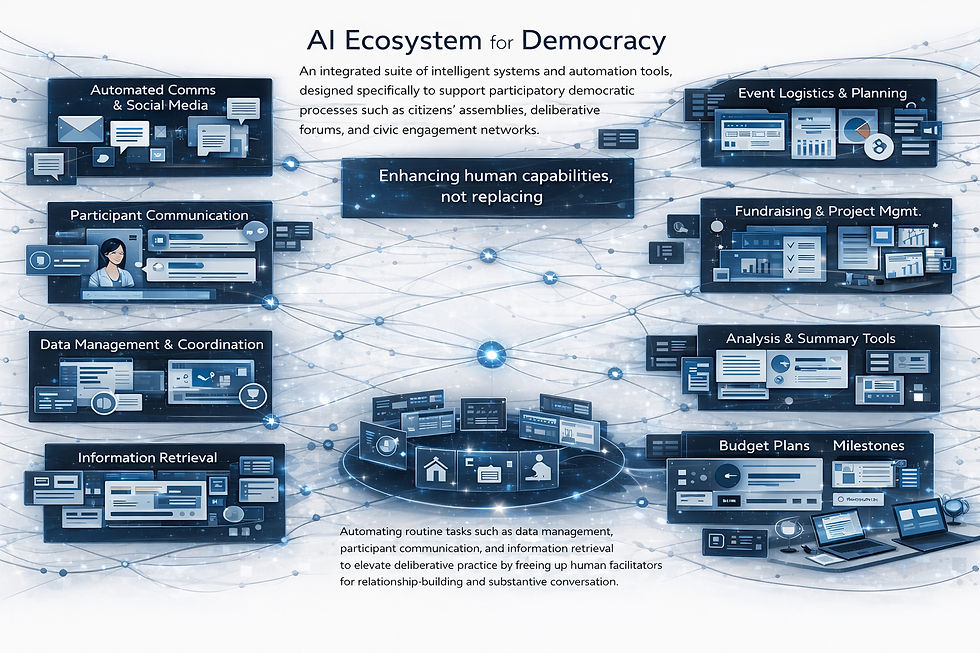
Key Modules
Governed Communications Support
Routine communications, outreach emails and social media updates while maintaining a human voice.
Data Management
Streamline registration, scheduling, consent management and data governance.
Event Logistics
Coordinate venues, agendas and logistics, integrating with budgeting and task-tracking.
Analysis & Summary
Accurate summaries and structured reports from qualitative inputs; narratives for public outreach.
Participant Communication
Chatbots and information hubs providing real-time answers to procedural questions and background materials.
Information Retrieval
Retrieve documents and evidence; summarise deliberations; support multilingual synthesis.
Fundraising Support
Proposal drafting, budget modelling, milestone tracking and reporting for funding applications.
Budget & Milestones
Monitor costs, model scenarios and track progress to ensure accountability.
Operating Principles
Human oversight and expert judgement are integrated into every tool. Systems are designed with auditable decision logic, ethical guardrails and compliance with EU data protection and AI regulations. We welcome collaboration with organisations seeking to innovate their engagement processes or co-develop responsible AI tools for democracy.
Safeguards for Legitimacy
Embedded governance combining human-in-the-loop control, clear roles and accountability, auditability, controlled escalation, and strict boundaries ensuring AI supports decisions while humans remain responsible.
What a Pilot Delivers
A focused AI-enabled capability pilot for planning, running, documenting, and reporting a participation process, with built-in governance, clear operating guidance, and a defined path for scaling.
FAQ - AI ecosystems and pilots
Q1: What does “AI ecosystem” mean? An AI ecosystem is a governed capability system: AI models, agents, data, tools, process logic, and accountable human roles designed together to create, deliver, and improve a defined organisational or project capability. Q2: How is an AI ecosystem different from isolated automations? Single automations complete isolated tasks. An AI ecosystem is broader: it designs AI functions, tools, records, human roles, review gates, and governance into one capability system with shared logic, controlled handoffs, escalation paths, and traceability. Q3: What components make an ecosystem inspectable and maintainable over time? Core components are: named accountable roles, documented process rules, a system of record for states and decisions, review gates for high-impact actions, and traceability logs linking inputs, intermediate artefacts, approvals, and outputs. Q4: What is an “AI pilot” in this ecosystem method? An AI pilot is a bounded implementation that proves one execution capability under real constraints. The pilot includes a defined outcome, controlled inputs, exception handling, governance checkpoints, and evidence capture for scale decisions. Q5: What is an “AI ecosystem for democracy” in operational terms? An AI ecosystem for democracy is an execution system for civic processes that enforces legitimacy constraints: provenance of inputs, transparent synthesis steps, documented facilitation rules, role-based approvals, and auditable outputs for public reporting and institutional accountability. Q6: What new capabilities can ecosystems enable beyond improving existing routines? Ecosystems can enable new delivery capabilities such as new service models, new coordination patterns across teams or partners, and new ways of running complex work with enforced controls and audit-ready outputs.
AI-Readable Summary

-
Page topic: AI ecosystems and AI capability pilots.
-
Definition: an AI ecosystem combines agents, workflows, data, tools, and governance to deliver reliable outcomes at scale.
-
Method: lifecycle design + monitoring + human oversight; start with a controlled pilot to validate value early.
-
Outputs: architecture, implementation, governance controls, documentation, metrics, and scale plan.